Your Guide To Choosing the Right Transfer for Custom Printing
If you’ve been exploring custom apparel or promotional products, you’ve probably seen the acronyms “DTF” and “UVDTF” tossed around a lot lately. But what do they actually mean? And more importantly, which one is right for your next project? Let’s break it down in plain English—no jargon, just facts, examples, and a few helpful tips from the shop floor.
DTF: Direct-to-Film Transfers
How Does DTF Work?
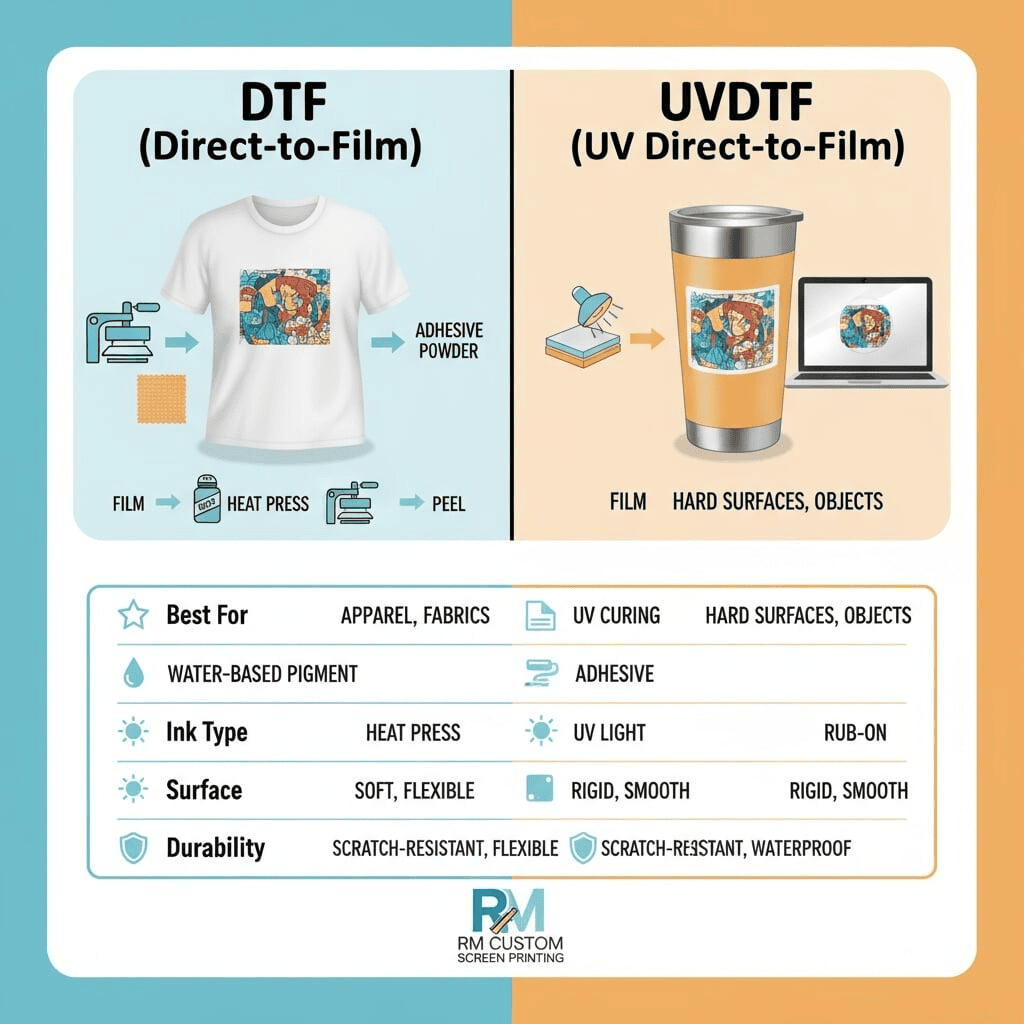
Print the Design: The artwork is printed in reverse onto a clear PET film using a special DTF printer and ink.
Apply Adhesive Powder: The wet ink is coated with a fine adhesive powder (think powdered sugar, but for shirts).
Cure the Film: The film is heated to melt the powder, bonding it to the ink and creating a ready-to-transfer sheet.
Heat Press: The film is placed on the garment, then pressed with heat and pressure to transfer the design.
Peel and Reveal: The film is peeled away, leaving a vibrant, durable print behind.
Where DTF Shines:
Versatility: Works on cotton, polyester, blends, and even some hard goods.
Detail: Handles full-color, photo-quality images and fine details.
No Minimums: Great for one-offs or small batches.
Feel: Leaves a soft, flexible print that moves with the fabric.
UVDTF: UV Direct-to-Film Transfers
How Does UVDTF Work?
Print with UV Ink: The design is printed onto a film using UV-curable inks.
UV Curing: As the ink is laid down, it’s exposed to UV light, which instantly hardens (cures) the ink on the film.
Adhesive Layer: A sticky adhesive is applied to the cured design.
Transfer: The film is pressed onto the surface of the item (like a tumbler), and the design is rubbed on, similar to a sticker or a decal.
Peel Off: The carrier film is peeled away, leaving a vibrant, durable image behind.
Where UVDTF Shines:
Hard Goods: Bonds to glass, metal, plastic, ceramics, and more.
No Heat Needed: No heat press required—just pressure and a good rub.
Full-Color Prints: Handles gradients, photos, and fine details.
Durability: UV-cured inks are tough, scratch-resistant, and long-lasting.
Key Differences at a Glance
Feature | DTF | UVDTF |
Best For | Apparel & soft goods | Hard goods (tumblers, mugs, etc.) |
Ink Type | Water-based pigment | UV-curable ink |
Curing Method | Heat (oven/hot press) | UV light |
Transfer Process | Heat press required | Pressure/rub-on (no heat) |
Surface Compatibility | Fabrics (cotton, poly, blends) | Hard, smooth surfaces |
Durability | Washable, flexible | Scratch/UV resistant, waterproof |
Order Size | Great for small runs & bulk | Ideal for custom, small batch |
Real-World Examples
Pros & Cons
DTF Pros:
Works on nearly any fabric
Soft, stretchable prints
Affordable for small runs
Handles complex images
DTF Cons:
Not ideal for hard goods
Requires a heat press
May feel thicker than screen print on some fabrics
UVDTF Pros:
Bonds to almost any hard, smooth surface
No special heat equipment needed
Extremely durable & scratch-resistant
Great for full-color, photo-quality designs
UVDTF Cons:
Not for fabrics or flexible surfaces
Newer technology—availability and pricing may vary
Requires clean, smooth surfaces for best results
Which One Should You Choose?
For Apparel: DTF is king—versatile, affordable, and perfect for everything from single tees to bulk orders.
For Drinkware & Hard Goods: UVDTF is the rising star—vivid, durable, and opens up a world of custom possibilities.
If you’re not sure which is right for your project, don’t sweat it. At RM Custom Screen Printing, we offer both options and can help you choose the best process for your needs, budget, and timeline.
Final Thoughts
The world of custom printing is always evolving, and new tech like UVDTF is making it easier than ever to create one-of-a-kind products. Whether you’re launching your brand, gifting your team, or just want something unique, understanding the difference between DTF and UVDTF means you’ll get the best results—every time.
Have questions or want to see samples? Reach out to us! We’re always happy to talk shop, show off our latest projects, or help you bring your vision to life.